The developer of the game Phantom Doctrine is the Polish studio CreativeForge Games. The game may require more than forty hours of play, and has three story campaigns. Designed for fans of turn-based tactics.
The action of the game develops in the mid-1980s. At the center of the cold war, world political leaders clung to each other’s throats with new force. The situation is unstable, both sides are waiting for only a pretext to grab the weapon, or are trying to create this excuse.
The player will lead a spy agency with a mobile base and a network of agents around the world. The game is divided into two parts: work in the office and work “in the field.” This is both a calm, multi-faceted manager and a tense step-by-step tactical action.
The player in the role of one of the three (in the story campaign for each) leading agents of the “Consent” will reveal the true objectives of the project. What did the submarine HMS Conqueror carry? What is MK Ultra? Why is the “Observer” disguised as a human rights organization? You have every imaginable power, but in case of force majeure there will be no one to rely on. De jure “Consent” does not exist. No one will throw funding from nowhere and will not take responsibility for your actions.
Agents have different skills and career circumstances. Depending on the service record, your specialists can better handle a certain weapon or have some abilities, but no more. “Consent” values versatility above all else.
Characters have passive and active skills. Passive skills, of course, improve stealth, reduce weapon reloading, increase the number of cells that characters can walk on. The active ones are concerned with specializations: some agents can open locks, while others do not, some can quickly help wounded comrades, while others need to spend more action points.
It is also possible to pump the base. The base is pumped over like the characters: new methods of encryption and decryption are being opened, masking, noise isolation, and so on are improved. To finish building new beds, first-aid post needs to be expanded.
At the base itself, agents can be treated, pumped, dressed, sent to assignments, monitor their safety, respond to their requests and, in general, ensure that they are busy and do not die.
On paper, this complication is much more interesting than it actually is, the reality is much more prosaic: at the heart of Phantom Doctrine is crisis management. In a strategic meta-game, you gradually expand the agent network, improve headquarters, recruit recruits and deal with organizational issues: training wards, their equipment and prioritization. And at the tactical stage, you command field operations personally.
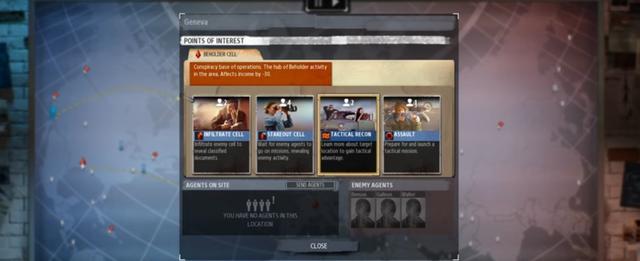
On the strategic layer, you rather play cat and mouse with conspirators. The radio operators of the “Consent” mark the transmissions from all points of the globe, but you will not know what is happening in this or that city until you send an agent there. Your operatives cannot physically “teleport” to the other end of the world at the first whim: flights require precious time. Therefore, Phantom Doctrine makes it necessary to create a real agent. Distribute people to as many appearances as possible in order to instantly react to new intelligence, if necessary.
The sooner the radio operators can verify the information on time, the informant will be able to transmit important intelligence information, and if he is late and does not check the radio operators’ information, the informant may, without waiting for a liaison officer, go back into the underground. So, it will not give you confidential documents – the most important resource for counterintelligence and progress on the plot.
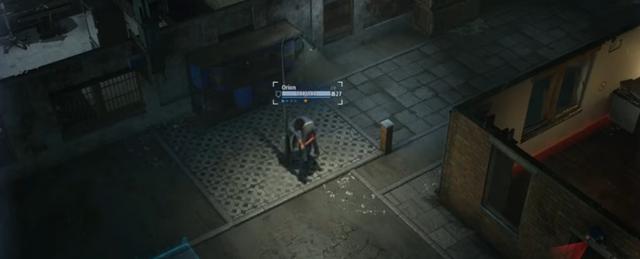
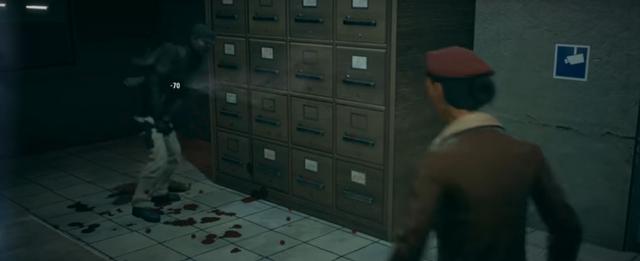
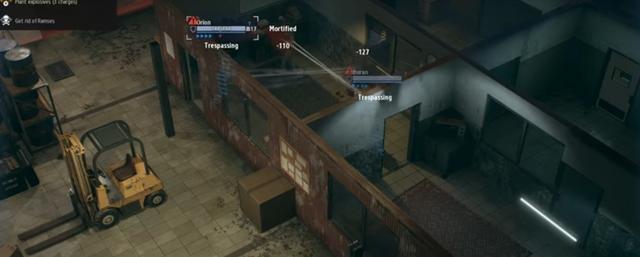
The system of tactical battles in Phantom Doctrine is designed in such a way that when completing tasks you can not make a single shot. the game admits stealth, but never forces it. Entering into a shootout, using firearms with enemy agents are not extremely profitable, as they cause reinforcement. Even the heaviest body armor and the coolest gun will not be able to give guarantees for the rescue agent. Almost all enemy units do not miss, but each agent has its own “attention” indicator, which is spent either on the ability of the agents or on avoiding shots.