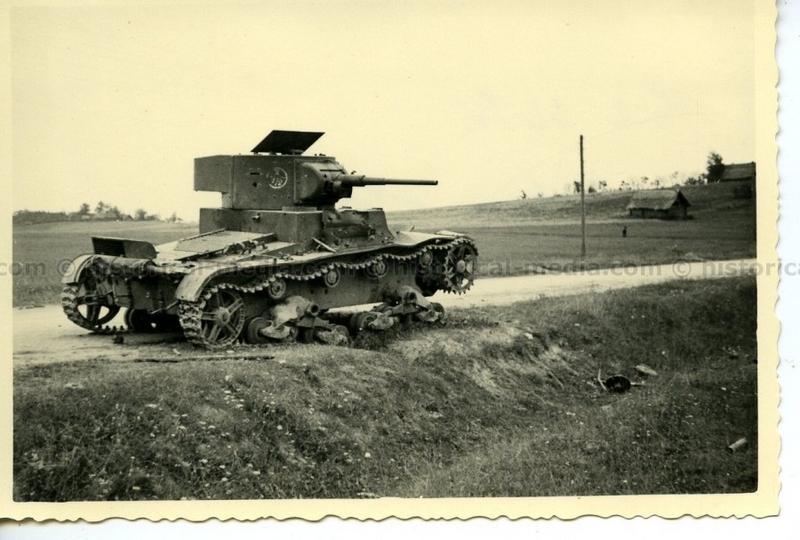
The baptism of fire the Soviet light tank T 26 received in Spain.
On July 18, 1936, a rebellion against the government of the republic began in this country, led by General Francisco Franco. The rebellion was supported by most of the army of the Civil Guard and the police. Having landed the African army in mainland Spain, within a few weeks Franco captured half of the country. But in the large industrial centers of the north – Madrid, Barcelona, Valencia, Bilbao and others, the rebellion failed. In Spain, a civil war broke out.
Yielding to the request of the republican government, the government of the USSR decided to sell the military equipment to the Spaniards and send military advisers, including tankers, to Spain.
On September 26, 1936, the first batch of 15 T 26 tanks arrived at the port of Cartagena, which was supposed to be used for training Spanish tankers. But the situation was complicated, and these tanks went on to form a tank company, the command of which was taken by the captain of the Red Army P. Arman. Already on October 29, the company entered the battle.
On November 1, the tank group of Colonel S. Krivoshein struck, which included 23 T 26 and nine armored vehicles. At the same time, Spanish crews were on the part of the cars.
From the beginning of December 1936, T 26 tanks and other military equipment, as well as personnel led by brigade commander D. Pavlov, began to arrive in Spain in droves. The commanders and mechanics drivers were military personnel. Directed from the best units and formations of the Red Army: the mechanized brigade named after Volodarsky (Peterhof), the 4th mechanized brigade (Bobruisk), the 1st mechanized corps named after K.B. Kalinovsky (city of Naro Fominsk). On the basis of almost 100 units of the arrived equipment and personnel, the formation of the 1st Republican Tank Brigade began. Mainly due to Soviet assistance, by the summer of 1938, the Republican army already had two armored divisions.
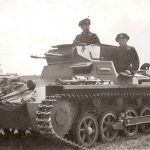
In total, until the end of the civil war, the Soviet Union delivered 297 T 26 tanks to Republican Spain (only 1933 single-turret vehicles were delivered). These machines took part in almost all military operations conducted by the Republican army, and showed themselves on the good side. The German Pz.1 and Italian CV3 / 33 wedges, which had only machine gun weapons, were powerless against the T 26. The latter circumstance can be illustrated by the following example.
During the battle near the village of Escivias, the T 26 Semen Osadchy tank rammed the Italian CV3 platform sole and dropped it into the gorge. The second platform sole was also destroyed, and the other two were damaged. The loss ratio was sometimes even greater. So, during the battle of Guadalajara in one day on March 10, a platoon of two T 26 under the command of the Spaniard E. Ferrera shot down 25 Italian wedges!
It should be emphasized that a worthy adversary opposed the Soviet tankmen. The rebel infantry, especially the Moroccan, having suffered heavy losses from the actions of tanks, did not leave the trenches and did not leave. The Moroccans threw grenades and bottles with gasoline at the war machines, and when they were not there, enemy soldiers with rifles at the ready threw themselves right under the tanks, beaten with rifle butts on their armor, clutched at the tracks.
The fighting in Spain, which demonstrated, on the one hand, the superiority of Soviet tanks over German and Italian in armament, on the other hand, revealed their main drawback – the weakness of the reservation. Even the T 26 frontal armor was easily penetrated by German and Italian anti-tank guns.
The first combat operation of the Red Army with the use of the T-26 tank in the Japanese conflict.
The first combat operation of the Red Army, in which T 26 tanks participated, was the Soviet Japanese armed conflict near Lake Hassan in July 1938. To defeat the Japanese group, the Soviet command attracted the 2nd mechanized brigade, as well as the 32nd and 40th separate tank battalions. The Soviet tank group consisted of 257 T 26 tanks, including 10 HT 26, three ST 26, 81 BT 7 bridge stackers (in the reconnaissance battalion of the 2nd mechanized brigade) and 13 self-propelled guns SU 5 2.
Even before the outbreak of hostilities 2 I mechanized brigade suffered significant losses. On July 27, three days before speaking in the battlefield, her commander, brigade commander A.P. was arrested. Panfilov, chief of staff, commissar, battalion commanders and several other units. All of them were declared enemies of the people. As a result, 99% of the command staff were newly appointed people, which negatively affected the subsequent actions of the brigade. So, for example, due to poor organization of the movement of columns and rush, a march with a length of only 45 km the brigade passed in 11 hours!
At the same time, part of the units, due to complete ignorance of the route of movement, wandered for a long time around the city of Voroshilov Ussuriysky.
During the assault on the hills occupied by the Japanese, the Mantis and Zaozernaya, our tankers came across a well-organized anti-tank defense. As a result, 85 T 26 tanks were lost, of which 9 were burned. After the end of hostilities, 39 tanks were restored by the forces of military units, and the rest were repaired in the factory.
The main burden of the fighting tank units in Mongolia near the river. Khalkhin Goal “laid on the shoulders” of BT wheeled tracked tanks. As of February 1, 1939, as part of the 57th Special Corps, there were only 33 T 26, 18 XT 26 tanks and six tractors based on the T 26. Beteshek, for comparison, there were 219 units. The situation has changed little in the future. So, on July 20, 1939, in the units of the 1st Army Group there were 10 XT 26 tanks (in the 11th Panzer Brigade) and 14 T 26 tanks (in the 82nd Infantry Division). By the August battles, the number of “twenty-sixths”, mainly chemical ones, increased slightly, but still they amounted to a relatively small percentage of the total number of tanks participating in the battles. Nevertheless, they were used quite intensively.
According to the results of the battle, it was revealed that T 26 – showed themselves exclusively on the good side, walked along the dunes very well, and the tank was very durable. In the 82nd Infantry Division, there was a case when the T 26 had five hits from a 37 mm gun, spread the armor, but the tank did not catch fire and after the battle came under its own power to the emergency vehicle assembly point. T-26 tanks easily penetrate the Japanese 37 mm cannon.