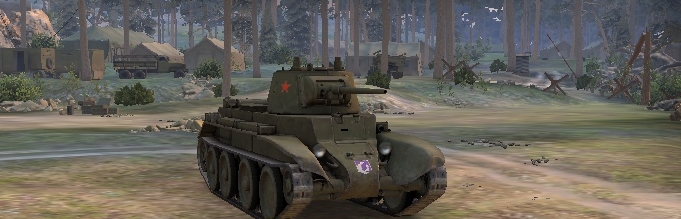
The first mass application of T 60 refers to the battle of Moscow. They were available in almost all tank brigades and individual tank battalions defending the capital. On November 7, 1941, 48 T 60 tanks from the 33rd Tank Brigade took part in the parade on Red Square. These were tanks of Moscow production, the Gorky T 60s first entered battle near Moscow only on December 13th.
The T 60s began to arrive at the Leningrad Front in the spring of 1942, when they formed the 61st Tank Brigade. 60 vehicles with crews were allocated. The story of their delivery to the besieged city is not without interest. The tanks decided to transport on barges with coal. It was not bad in terms of disguise. Barges delivered fuel to Leningrad, became familiar with the enemy, and not every time they were actively hunted. In addition, coal, like ballast, provided river vessels with the necessary stability.
They loaded combat vehicles from the pier above the Volkhov hydroelectric power station. Log floorings were laid on coal, tanks were placed on them, and barges set sail from the shore. Enemy aircraft could not detect the movement of our military unit.
The baptism of fire of the 61st Tank Brigade occurred on January 12, 1943 – the first day of the operation to break through the blockade of Leningrad. Moreover, the brigade, like the 86th and 118th tank battalions, also armed with light tanks, operated in the first echelon of the 67th army and crossed the Neva on ice. Units equipped with medium and heavy tanks were brought into battle only on the second day of the offensive, after a bridgehead of 2-3 km in depth was captured, and sappers reinforced the ice.
The crew of T 60 showed special courage, heroism and resourcefulness during the offensive. In which was the commander of the company of the 61st tank brigade, Lieutenant D.I. Osatyuk, and the foreman was I.M. Makarenkov. Here is how this episode is described in the collection “Tankers in the Battle of Leningrad”: “Having rushed forward, at dawn on January 18 at Workers’ Village No. 5, they noticed three tanks. The Volkhovites wanted to jump out of the car, run towards, but saw that it was Hitler’s tanks The tank commander gave the command to the mechanic the driver: “Depart to the grove on the edge of which our guns took firing positions!”
The tank, maneuvering, making unexpected and sharp turns, eluded the fire of Nazi tanks. And Osatyuk fired at them, tried to blind, stun the enemy. The duel lasted several minutes. There were moments when it seemed that armored monsters would overtake, lean and crush. When the grove was about 200 meters away, Osatyuk’s car turned sharply to the left. Hitler’s head tank also turned around, but fell under the fire of our guns and burned. Then the second tank was shot down, and the third left the battlefield.
Having caught up with their company, they saw an interesting picture – the tankers drove the enemy infantry into a huge pit. The Nazis stubbornly resisted, threw grenades at our tanks. It was clear that it was impossible to procrastinate: the Nazis had time to dig in. Osatyuk orders Makarenkov to roll a trace to the cliff, to track. Then the tank, gaining speed, rushed to the pit, flew in the air and crashed into the Nazis.
The car rushed at high speed along the bottom of the pit, destroying the Nazis with fire and caterpillars. After making several circles, the tank slowed down, went to the middle of the pit and stopped. They approached their own.
Measures were taken to strengthen the armor protection of the tank. At the suggestion of the Izhora armored research institute 48, which was transferred from the People’s Commissariat of the shipbuilding industry to tank building with the outbreak of war. Several options were developed and implemented on many machines for installing additional armored screens up to 10 mm thick on the front of the hull and on the turret of the T 60 tank.
As for the 61st Tank Brigade, its tanks were the first to join the forces of the Volkhov Front. For excellent military operations she was transformed into the 30th Guards. Lieutenant D.I. Osatyuk and mechanics to the driver foreman I.M. Makarenkov was awarded the title Heroes of the Soviet Union.
The Soviet T 60 light tanks also fought on the Southern Front. Especially active in the spring of 1942 in the Crimea, participated in the Kharkov operation and in the defense of Stalingrad. The Germans called the T 60 “indestructible locusts” and were forced to reckon with them.
The Soviet light tanks T 60 made up a significant part of the combat vehicles of the 1st tank corps, the commander was Major General M.E. Katukov. Together with other units of the Bryansk Front, which reflected the German offensive on the Voronezh direction in the summer of 1942. During the fighting, the Katukov corps, which formed a single combat group with a 16 m tank corps, fell into a difficult position.
The Germans managed to find the most vulnerable spots in the battle formations of the groups. In the area where we had little firepower, the fascist infantry broke through the front line and wedged into our defense. The situation was threatening. Having made a breach, the Nazis continued to deepen the breakthrough. In order to divide the troops of the group and go to their rear.
It should also be taken into account that at this moment the enemy was pressing along the entire front line. And all the available forces of our group, tanks and infantry, were fully involved. To fight against German tanks, the T 60s were unsuitable. But against the enemy’s manpower, the Soviet T-60 light tanks acted excellently. And more than once with their automatic fire inflicted tremendous damage to the fascist infantry. So it was near Mtsensk, and near Moscow.
Fascist infantry wedged into our defenses for half a kilometer. Fortunately, rye at that time rose almost to the height of a person. And this helped the Soviet T – 60 tanks, hiding in the rye, get behind the Nazis. T 60 from a short distance heavy fire fell on the German infantry. And after a few minutes the advancing fascists were driven back.
By the beginning of the counterattack of the Stalingrad, Don and South Western fronts on November 19, 1942. As part of the tank brigades, there were already quite a few fighting vehicles of this type. The insufficiently armored and lightly armed T 60 had very low stability on the battlefield, becoming easy prey for medium and heavy enemy tanks. In fairness, it must be admitted that the tankers did not particularly like these lightly armored and lightly armed vehicles with fire hazardous gas engines.
The last major operation in which the T 60 was used was the lifting of the blockade from Leningrad in January 1944. So, among 88 tanks of the 1st Tank Brigade of the Leningrad Front there were 21 T 60 tanks, in the 220th Tank Brigade there were 18. And in the 124th Tank Regiment of the Volkhov Front, by the beginning of the operation on January 16, 1944, only 10 combat vehicles were available: two T 34, two T 70, five T 60 and even one T 40.
Subsequently, the use of T 60 as:
Troop escort vehicles on the march.
Security and communications.
For reconnaissance in battle.
Fighting landings.
As towing vehicles for towing anti-tank guns ZIS 2 and division ZIS Z.
As command and training tanks.
As such, the T 60 was used in the army until the end of World War II, and as tractors were used in the war with Japan.
On the basis of the T 60 tank was produced:
Jet installation BM 8 24 (1941).
Prototypes of a tank with a 37 mm ZIS 19 cannon were developed and manufactured.
37 mm self-propelled anti-aircraft guns (1942).
2 mm self-propelled artillery mounts.
Anti-aircraft tank T 60 3 with two coaxial 12.7 mm DShK machine guns (1942).
And self-propelled artillery mounts OSU 76 (1944).