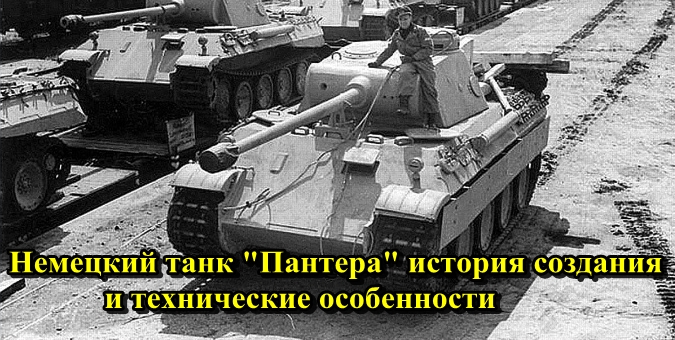
The German tank Panther is one of the most famous tanks that took part in World War II. The reason for the creation of this war machine, which was not foreseen in the Wehrmacht’s tank weapons system, was the Soviet T 34 medium tank. On July 18, 1941, Rheinmetall received an order to develop a 75 mm long-barreled gun capable of piercing 140 mm armor at a distance of 1000 m. On November 25, Daimler Benz and MAN an order was issued for a 35 ton tank. The tactical technical requirements for the new combat vehicle were put forward by the following: width – up to 3150 mm, height – 2990 mm, engine with a power of 650 – 700 hp, armor protection – 40 mm, maximum speed – 55 km / h. The task received a conditional name – “Panther”.
The original code name was set by designers as Pz.Kpfw.V. And the name of the Panther tank was introduced by order of Hitler on February 27, 1944. The first two tanks – V1 and V2 (V – Versuch – experience) were manufactured by September 1942, which differed from each other in insignificant details. On November 3, one of the cars, with a model instead of a real tower, was shown to Speer at a training ground in Bad Berka. During the tests revealed significant shortcomings in the chassis. It took time to eliminate them, and this delayed the start of mass production. The order also provided for the production of 250 tanks in a fairly short time – by May 12, 1943. In addition, Hitler received an unexpected order to arm the Panther with a 75 mm cannon with a barrel length of 100 calibers. This gun was not yet ready, and the Fuhrer’s instructions did not aggravate the difficulties with the start of mass production.
The first production Panther left the MAN factory on January 11, 1943. Tanks of the “zero” series (20 units) received the designation Ausf.A. They had nothing to do with the machines of the same name, produced since September 1943. A characteristic feature of the first production “panthers” was the commander’s cupola with a protrusion on the left side of the tower and a single-chamber muzzle brake of the gun. The tanks were equipped with Maybach HL 210P45 engines, Zahnradfabrik ZF7 gearbox and had frontal armor 60 mm thick. They were used only in the rear for the training of crews. Since February 1943, the designation of machines in this series has changed to Ausf.D.
German tank “Panther” from the Pz.Kpfw.V Ausf.D. series
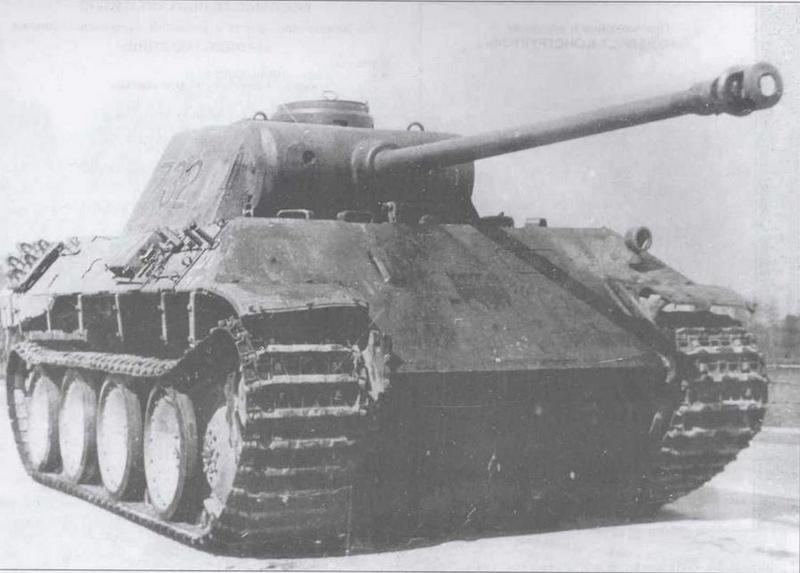
The German tank Panther from the Pz.Kpfw.V Ausf.D series differed slightly from prototypes and vehicles of the “zero” series. The changes affected mainly the commander’s cupola and the muzzle brake of the gun. Increased the thickness of the frontal armor to 80 millimeters. The Maybach HL 230P30 engine and AK 7 200 type gearbox were installed on the tanks. The commander’s turret was similar to the turret of the Tiger tank on tanks manufactured in the first half of 1943.
Later, the commander’s cupola was replaced with a new one. The new turret had seven periscope surveillance devices along the perimeter and a special ring for installing the MG 34 anti-aircraft machine gun. NbK 39 mortars were mounted on the sides of the tower to launch 90 millimeter smoke grenades. The Panther tanks, which were produced in the second half of the year in armor design, were covered with zimmerite, as well as equipped with bulwarks made of 5 mm armor plates.
A characteristic feature of the D-series machines is the lack of a ball-mounted machine gun. This machine gun was located inside the tank and was inserted only into the narrow vertical slot for shooting, which was closed by a hinged lid. As well as the presence on the left side of the tower of a round hatch for ejecting spent cartridges and loopholes for firing personal weapons in the sides and aft of the tower.
The first batch of Panthers was planned to be manufactured by May 12, 1943. However, during February and March, the military did not accept most of the 77 units of manufactured tanks, and in April they did not accept any. By the end of May, the Wehrmacht received the long-awaited 324 Panthers. Adopted Panther tanks equipped the 10th tank brigade. After the introduction of new tanks into the tank, tankers had problems with the development of the complex binocular sight TZF12. So difficulties with the production and development of the first “panthers” in the troops affected the timing of the German summer offensive on the Eastern Front in 1943.
German tank “Panther” from the series Pz.Kpfw.V Ausf.A.
In September 1943, the release of the next modification of the Panther began – Ausf.A.
The following changes have been made:
appeared ball mount machine gun in the frontal sheet of the body.
eliminated the hatch for ejecting spent cartridges and loopholes for firing with personal weapons on the sides of the tower.
instead of two headlights, only one was installed on the front of the hull.
The binocular scope was replaced with the monocular TZF12a. The elevation angle of the tank gun decreased from 20 ° (at Ausf.D) to 18 °.
German tank “Panther” from the Pz.Kpfw.V Ausf.G. series
The German tank Panther of the Ausf.G modification was the most massive of the three. 3740 tanks were made. Launch into mass production was introduced in March 1944.
https://i.postimg.cc/6Qd9HQKK/5.jpg
The new Ausf.G modification had the following features:
The side sheets of the hull received a tilt angle of 61 °.
The thickness of the side armor increased to 50 millimeters, and the frontal armor of the tower to 110 millimeters.
A driver mechanic’s stopper was removed from the frontal sheet of the body.
The machine gunner’s landing hatches and the driver’s mechanics took on a different form.
Some of the tanks of the later releases received a cannon mask with a kind of “skirt” in the lower part, which made it impossible to jam the tower when an enemy shell hit.
Gun ammunition increased by three shots.
Changes were made to the design of fans, engine shutters, exhaust pipes, etc.
Experiments were conducted on the use of various engines on the Panther: MAN / Argus LD 220 with air cooling and a power of 700 hp. (515 kW), an aviation star-shaped BMW 132D with a power of 650 hp (478 kW), diesel Daimler Benz MV 507 with a capacity of 850 hp (625 kW).
New transmission options were also tested – hydrostatic and hydrodynamic, underwater driving equipment and track rollers with internal shock absorption. However, all these innovations have not found application on serial machines. The flamethrower version of the Panther remained unrealized.
It was supposed to equip the car with a new turret with a 50 mm KwK 39 L / 60 cannon. This project was not accepted, since its weapons were considered insufficient, and linear tanks were used for reconnaissance purposes.
German tank Panther from the Pz.Kpfw.V Ausf.F. series
In 1943, the design of the next modification of the Panther Ausf.F. began. Which was significantly different from previous models. The most important innovation was the tower, called the Schmalturm. The tower was smaller than the standard and had a different design, which is why the tankers called it as a “cramped tower.” During 1944, several prototypes were manufactured and tested. And the design ended only in January 1945.
As a result, the tank received the following changes:
The thickness of the turret’s armor was 100 millimeters in the forehead, 50 millimeters in the side and rear, and 30 millimeters in the roof.
The embrasure for the TZF13 telescopic sight was still on the front sheet.
In the final version, the frontal armor increased to 120 millimeters, the side armor – up to 60 millimeters, and the roof armor – up to 40 millimeters.
A new stabilized TZF1 periscope sight and a Zeiss stereoscopic rangefinder were installed.
A range finder with a base of 1320 millimeters and a 15x magnification was located in front of the tower. On the sides of which there were armored caps for his eyepieces. The installation of a night vision device FG 1250 was also envisaged.
The cannon was upgraded at Skoda factories, the muzzle brake was removed. The improved gun received the KwK 44/1 index.
The MG 34 tower machine gun was replaced with the MG 42.
Instead of a course machine gun, an MP 44 assault rifle was installed.
Until the end of the war, not a single prototype appeared in its finished form. In total, eight buildings and two towers were made for the Panther with the Ausf.F modification.